
Rolex Day-Date: The Complete Encyclopedia of the President's Watch
The Rolex Day-Date, universally known as "the President," debuted in 1956 as the first wristwatch to display both the full day of the week, spelled out in an arched window at 12 o'clock, and the date at 3. Produced exclusively in 18k gold or 950 platinum since its inception, it has never been offered in steel or two-tone. The accompanying President bracelet, with its distinctive three-piece semi-circular links, was designed specifically for this model. Multiple U.S. Presidents from Lyndon Johnson through the modern era have worn it, cementing a nickname that Rolex eventually embraced in its own marketing. The collection spans two case sizes today: the classic 36mm (Ref. 128238 and siblings) and the 40mm Day-Date 40 (Ref. 228238 and siblings), both powered by the Cal. 3255 with 70-hour reserve. Vintage Day-Dates with Stella lacquer dials from the 1970s have become some of the most explosively collectible Rolex references at auction.
Last updated: 2026-04-01
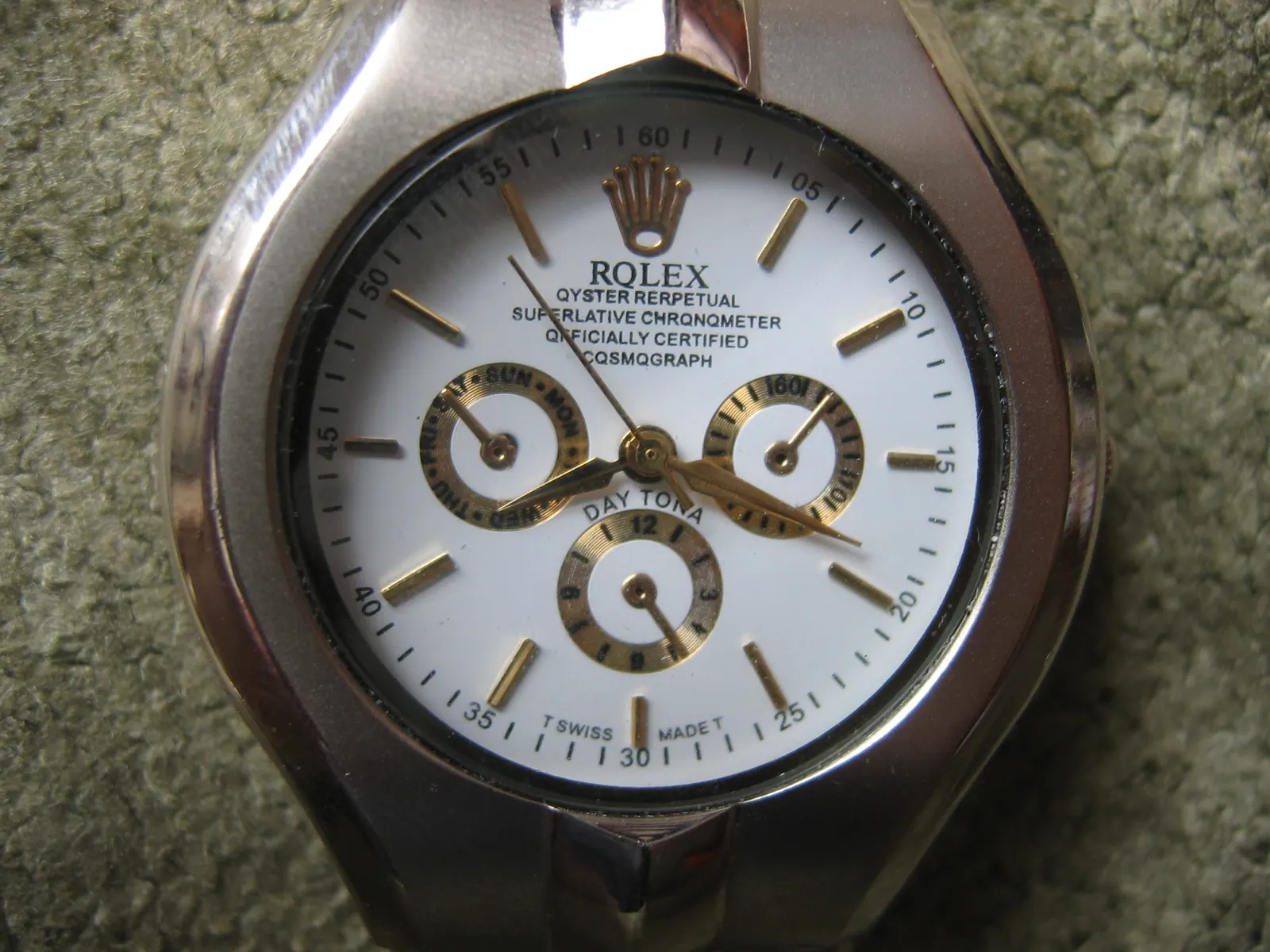
In stock now
2 pieces in the case on 47th Street.
Specifications
History
Iconic references
Buying guide
- • Verify the metal: there is no steel Day-Date. This is check number one. The Day-Date has NEVER been produced in stainless steel or two-tone Rolesor. If someone offers you a steel Day-Date, walk away immediately. Every Day-Date ever made is 18k gold or platinum.
- • Weigh the watch. A genuine Day-Date is heavy. A 40mm yellow gold Day-Date with bracelet weighs approximately 200-210 grams. A 36mm with solid links weighs around 155-175g. Fakes feel noticeably lighter due to base metals or hollow construction. A jeweler's scale is your first line of defense.
- • Check the bracelet type: President only. The Day-Date comes exclusively on the President bracelet (or occasionally a leather strap from factory). If you see a Day-Date on an Oyster or Jubilee bracelet, it's either a frankenwatch or a fake. The three semi-circular links of the President bracelet are unmistakable.
- • Examine the day wheel alignment. The full day-of-week display at 12 o'clock is a key authentication point. On a genuine Day-Date, the text is cleanly printed, evenly spaced, and perfectly centered in the window. Counterfeits often show text that's too thick, uneven, or poorly aligned.
- • Inspect the rehaut (post-2006 models). Modern Day-Dates have 'ROLEX ROLEX ROLEX' laser-engraved on the inner rehaut, with the serial number at 6 o'clock. Each 'ROLEX' must align perfectly with a minute marker. Misalignment is a counterfeit giveaway.
- • Test the Cyclops magnification. Genuine Rolex Cyclops lenses provide exactly 2.5x magnification and are anti-reflective coated (post-2005). Counterfeits typically offer 1.5x or less magnification. The date should appear to 'fill' the Cyclops window on a real piece.
- • Verify the movement: sweep, don't tick. The second hand on a genuine Rolex moves in a smooth, sweeping motion (approximately 8 beats per second). Any jerky, one-second ticking motion means it's a quartz movement, and Rolex has never put a quartz movement in a Day-Date.
- • Check the caseback: it should be blank. With extremely rare exceptions (some 1930s exhibition models), genuine Rolex casebacks are smooth, solid metal with zero engravings. Any 'exhibition' caseback showing a movement, or any engraved logos/text, is a guaranteed fake.
- • Assess the gold quality visually and chemically. Genuine 18k Rolex gold has a specific warmth and luster that base metals plated to look like gold cannot replicate. An acid test or XRF gun at a reputable jeweler can confirm the gold purity instantly. Look for any discoloration, wear-through, or brassy tones: signs of gold plating over base metal.
- • Confirm serial and model numbers. On vintage models (pre-2008), serial and model numbers are engraved between the lugs (visible only with bracelet removed). On modern models, the serial is on the rehaut. Numbers should be deeply, sharply, and evenly engraved. Shallow, wandering, or blurry engravings indicate counterfeits.
Buying a Day-Date is different from buying a Submariner or a Daytona. You're dealing with precious metals, which means higher stakes, different authentication concerns, and a market that moves with gold prices as much as with hype. Here's what a seasoned dealer on 47th Street wants you to know.
Pricing & market data
Best value pick
Ref. 18238 (1988-2000): the double-quickset generation in 18k yellow gold with Cal. 3155, the Day-Date Tupac and Jay-Z made iconic. Trading at $18,000-$25,000 pre-owned, it's the sweet spot of modern usability, cultural cachet, and gold-floor pricing.
Comparisons
Cultural significance
No watch in history bridges the gap between political power and street culture like the Rolex Day-Date. It's the only timepiece that's equally at home in the Oval Office and a rap video, and it earned both associations organically, not through marketing campaigns.
Frequently asked questions
Related guides
Audemars Piguet Royal Oak
The Audemars Piguet Royal Oak, Reference 5402ST, debuted at the Basel Fair on April 15, 1972, as the world's first
Read guide →Patek Philippe Nautilus
The Patek Philippe Nautilus, Reference 3700/1A, debuted in 1976 as a 39mm stainless steel sports watch designed by
Read guide →Omega Constellation
The Omega Constellation has been in continuous production since 1952, born from Omega's dominance at the Geneva and
Read guide →Cartier Santos
The Cartier Santos is the watch that invented the wristwatch as we know it. In 1904, Louis Cartier designed it for his
Read guide →Rolex Perpetual 1908
The Rolex Perpetual 1908 is the first proper dress watch Rolex has built in a long time, and the first thing collectors
Read guide →Rolex Air-King
The Rolex Air-King traces its lineage to 1945, when Hans Wilsdorf created a series of watches honoring Royal Air Force
Read guide →Sell your Rolex Day-Date
We buy Rolex watches on 47th Street. No obligation quote, fast payment.